
ADA Accessible Concrete Sidewalk & Ramp Construction
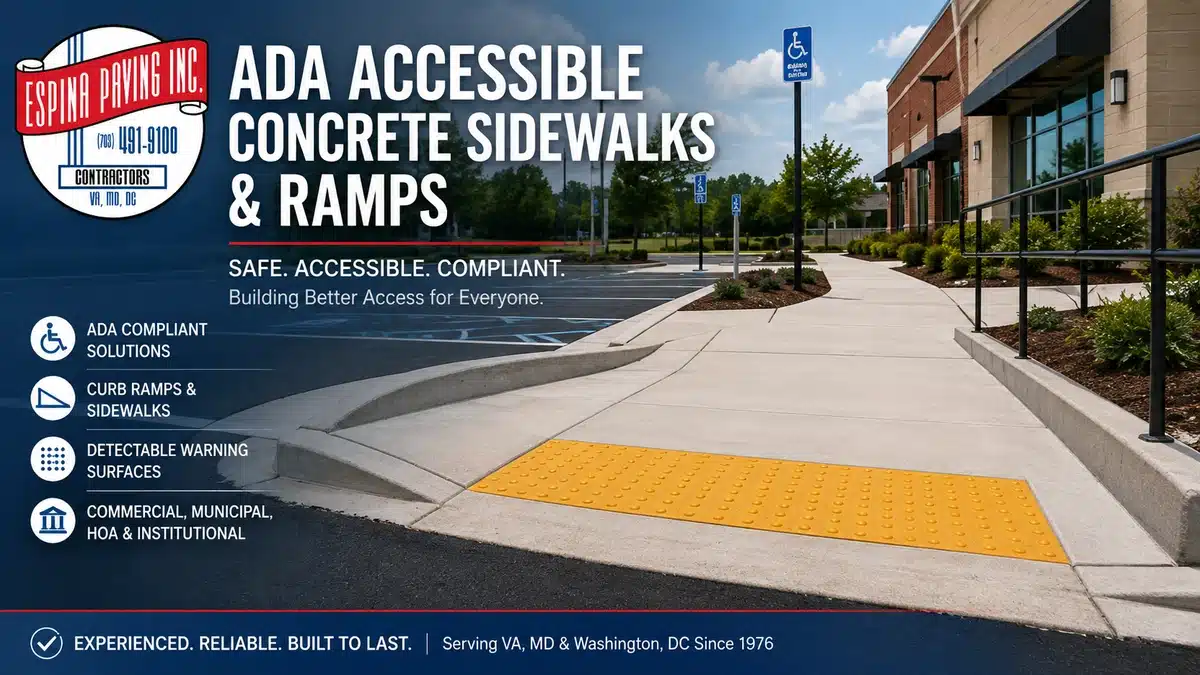
ADA accessible concrete sidewalk, curb ramp and detectable warning surface construction for commercial and municipal properties.
ADA Concrete Accessibility Solutions for Commercial and Municipal Properties
Accessible pedestrian routes are an essential part of commercial, institutional, multifamily and public properties. Sidewalks, curb ramps and transitions must be designed and constructed to provide safe, usable access for people with disabilities while meeting applicable accessibility requirements.
Espina Paving provides ADA accessible concrete sidewalk and ramp construction services throughout Northern Virginia, Maryland and Washington, D.C. Our experienced concrete crews construct and replace sidewalks, curb ramps, pedestrian routes and related concrete features for commercial properties, municipalities, government facilities, hospitals, HOAs, apartment communities and property managers.
Our ADA concrete services include:
- ADA accessible concrete sidewalks and walkways
- Concrete curb ramps
- Wheelchair-accessible ramps
- Detectable warning surfaces and truncated domes
- Accessible routes between parking areas and building entrances
- Sidewalk and parking-lot transitions
- Concrete landings
- Sidewalk slope and cross-slope corrections
- Removal and replacement of non-compliant concrete
- Trip-hazard and elevation-transition corrections
- Concrete curbs and gutters associated with accessible routes
- ADA accessibility upgrades for existing commercial properties
For additional concrete construction, repair and replacement capabilities, visit Espina Paving's Commercial Concrete Contractor service page.
What Is an ADA Accessible Concrete Sidewalk?
An ADA accessible sidewalk is more than a standard concrete walkway. It is part of an accessible route designed to allow people with mobility disabilities to travel safely between parking areas, public sidewalks, building entrances and other accessible areas of a property.
An accessible route may incorporate sidewalks, walking surfaces, curb ramps, pedestrian ramps, parking access aisles and other components.
The ADA Standards establish technical requirements affecting features such as:
- Walking-surface width
- Running slope
- Cross slope
- Changes in elevation
- Curb ramps
- Ramp landings
- Surface conditions
- Transitions between sidewalks, gutters and streets
- Accessible connections to parking and building entrances
Proper construction is critical because even relatively small changes in elevation, excessive slopes or poorly designed transitions can create significant accessibility problems.
ADA Concrete Sidewalk Construction Requirements
ADA accessible routes require careful layout, grading and concrete placement. For walking surfaces that form part of an accessible route, ADA Standards generally establish a minimum clear width of 36 inches, a running slope no steeper than 1:20, and a cross slope no steeper than 1:48, subject to applicable exceptions and project-specific requirements.
Espina Paving evaluates the entire pedestrian route rather than treating an individual sidewalk slab as an isolated element.
That means considering how the sidewalk connects to:
Accessible parking → access aisle → curb ramp → sidewalk → building entrance
Each transition can affect the usability of the complete accessible route.
Our crews pay particular attention to elevations, grading, drainage, surface finish and transitions so that newly constructed concrete integrates properly with surrounding pavement and existing infrastructure.
ADA Concrete Curb Ramp Construction
Connecting Sidewalks, Parking Areas and Pedestrian Routes
Concrete curb ramps provide an accessible transition between sidewalks and areas separated by a curb, such as parking lots, roadways and pedestrian crossings.
Espina Paving constructs and replaces ADA concrete curb ramps for commercial and public properties throughout the Washington, D.C. metropolitan area.
Depending on the project and site conditions, curb-ramp construction may involve:
- Removal of existing curb and sidewalk
- Excavation and subgrade preparation
- Concrete curb modifications
- Ramp construction
- Top landings
- Flared sides where required
- Detectable warning surfaces
- Gutter and roadway transitions
- Drainage corrections
- Connections to existing sidewalks
- Asphalt restoration around the new concrete
ADA curb ramps require precise construction because the ramp, landing, gutter and adjoining pavement work together as a single pedestrian transition.
What Is the Maximum Slope for an ADA Ramp?
Under the ADA Standards, ramp runs generally cannot have a running slope steeper than 1:12. Curb ramps are also subject to specific slope, landing and transition requirements.
The adjoining surfaces are equally important.
At curb ramps, transitions between the ramp, sidewalk, gutter and street should be designed to avoid abrupt level changes that could interfere with wheelchair movement or create pedestrian hazards.
Espina Paving's experience with both commercial concrete and asphalt paving is particularly valuable on these projects because accessible routes frequently cross the boundary between concrete sidewalks and asphalt parking lots or roadways.
Detectable Warning Surfaces and Truncated Domes
ADA Detectable Warning Installation at Curb Ramps
Detectable warning surfaces alert pedestrians who are blind or have low vision that they are approaching a transition or potential hazard along a pedestrian circulation route.
These surfaces use a standardized pattern of truncated domes that can be detected underfoot or with a cane.
Where required, Espina Paving can incorporate detectable warning surfaces into new or reconstructed concrete curb ramps and pedestrian transitions.
Proper installation requires coordination between the warning surface and the surrounding concrete so that the completed ramp maintains appropriate elevations, slopes and transitions.
Detectable warning surfaces should also provide visual contrast with adjacent walking surfaces where required.
ADA Accessible Routes from Parking Lots to Building Entrances
For many commercial properties, accessibility begins in the parking lot.
An accessible pedestrian route may need to connect:
Accessible parking spaces → parking access aisles → curb ramps → sidewalks → accessible building entrances
Problems anywhere along this route can affect accessibility.
Espina Paving can evaluate and construct the concrete and paving components needed to create a continuous accessible pedestrian route through commercial properties.
Typical projects include:
Shopping Centers and Retail Properties
Accessible routes connecting parking spaces, storefronts, sidewalks and pedestrian crossings.
Office Buildings and Business Parks
Concrete sidewalks, ramps and transitions connecting employee and visitor parking areas with accessible entrances.
Apartment and Condominium Communities
Accessible walkways and curb ramps connecting parking areas, residential buildings, community facilities and common areas.
Hospitals and Healthcare Facilities
Accessible pedestrian routes serving patient entrances, medical offices, parking areas and passenger loading areas.
HOA and Townhouse Communities
Sidewalk and curb-ramp improvements throughout community streets, common areas and pedestrian networks.
Government and Municipal Facilities
Concrete accessibility improvements for public buildings, parks, sidewalks, municipal facilities and pedestrian infrastructure.
Correcting Non-Compliant or Deteriorated Concrete Sidewalks
When Does an Existing Sidewalk Need ADA Accessibility Improvements?
An accessible route that was originally constructed correctly can develop problems over time.
Tree roots, settlement, freeze-thaw cycles, drainage problems, utility work and repeated pavement repairs can change sidewalk elevations and slopes.
Common accessibility and pedestrian-safety problems include:
- Raised or sunken sidewalk slabs
- Excessive cross slopes
- Steep sidewalk transitions
- Deteriorated curb ramps
- Missing or damaged detectable warnings
- Abrupt changes in level
- Cracked or deteriorated concrete
- Poor transitions between concrete and asphalt
- Drainage problems at curb ramps
- Ponding water within pedestrian routes
- Sidewalks obstructed by deteriorated curbs or surrounding pavement
Depending on the condition, an isolated repair may solve the problem. In other situations, removing and replacing the affected sidewalk or curb-ramp section provides a better long-term solution.
Espina Paving can evaluate existing concrete conditions and recommend an appropriate repair or replacement approach.
ADA Sidewalk Slope and Cross-Slope Corrections
Slope is one of the most important considerations when constructing an accessible pedestrian route.
A sidewalk that appears nearly level can still present accessibility problems if its running slope, cross slope or transitions exceed applicable requirements.
Correcting these conditions may require more than replacing a single slab. Elevations may need to be coordinated across multiple sections of sidewalk, curbs, parking areas, entrances and drainage structures.
Our crews establish grades before concrete placement and coordinate the new surface with surrounding elevations to create smooth, functional transitions while maintaining appropriate drainage.
ADA Sidewalk Transitions and Trip Hazard Corrections
Changes in level between adjoining sidewalk slabs can create both accessibility problems and pedestrian trip hazards.
These elevation differences commonly result from:
- Tree-root growth
- Soil settlement
- Poor subgrade compaction
- Water infiltration
- Freeze-thaw movement
- Previous utility repairs
- Deteriorated concrete
- Improperly constructed replacement slabs
Espina Paving provides concrete repair and replacement solutions for commercial sidewalks and accessible routes.
Where replacement is required, deteriorated concrete can be removed, the underlying base corrected and new concrete installed at appropriate elevations to provide a smoother transition to adjoining surfaces.
Our ADA Concrete Construction Process
Every property presents different grading, drainage and accessibility challenges. Espina Paving approaches ADA concrete construction as a coordinated site-improvement project.
1. Site Evaluation
We review existing sidewalks, ramps, curbs, parking areas, entrances, elevations, drainage conditions and pedestrian traffic patterns.
2. Accessible Route Planning
The route is evaluated to determine how pedestrians will travel between accessible parking, sidewalks, ramps and entrances.
3. Existing Concrete Removal
Where necessary, deteriorated or improperly configured concrete is saw-cut, removed and prepared for replacement.
4. Subgrade and Base Preparation
Proper preparation and compaction help minimize future settlement that could alter elevations and create accessibility problems.
5. Forms, Grades and Slopes
Forms are established according to the required elevations and project specifications. Particular attention is given to running slopes, cross slopes, landings and transitions.
6. Concrete Placement and Finishing
Concrete is placed, finished and textured to create a durable pedestrian walking surface.
7. Detectable Warning Installation
Where required, detectable warning surfaces are incorporated into curb-ramp construction.
8. Transition and Drainage Review
Connections to surrounding sidewalks, curbs, gutters and asphalt pavement are reviewed to provide smooth transitions and appropriate drainage.
ADA Concrete Construction for Commercial Properties
Commercial accessibility projects frequently require coordination among several areas of a property.
A project that begins with a deteriorated sidewalk may also involve a curb ramp, accessible parking access aisle, drainage correction or asphalt transition.
Because Espina Paving performs both commercial concrete and asphalt paving, we can address multiple components of these projects rather than treating each pavement surface separately.
This can be especially useful for:
- Shopping centers
- Office parks
- Apartment communities
- Condominium associations
- HOAs
- Industrial facilities
- Warehouses
- Hospitals and medical facilities
- Schools
- Churches
- Government facilities
- Municipal properties
ADA Concrete Construction for Municipal and Government Projects
Public pedestrian infrastructure presents its own accessibility challenges.
Municipal and government projects may involve sidewalks, street crossings, curb ramps, detectable warning surfaces and accessible routes connecting public facilities.
Espina Paving provides asphalt and concrete construction services for government and municipal customers throughout the Washington, D.C. metropolitan area.
Our concrete capabilities can support accessibility improvements involving:
- Municipal sidewalks
- Public building entrances
- Government parking facilities
- Pedestrian crossings
- Concrete curb ramps
- Detectable warning surfaces
- Accessible pedestrian routes
- Concrete curb and gutter
- Asphalt-to-concrete transitions
Why Choose Espina Paving for ADA Concrete Work?
Serving the Washington, D.C. Metropolitan Area Since 1976
ADA concrete construction requires more than simply pouring a sidewalk or ramp. Successful projects require careful grading, accurate elevations, durable concrete construction and coordination with surrounding pavement.
Espina Paving has served commercial, industrial, institutional, HOA, property-management and government customers throughout the Washington, D.C. metropolitan area since 1976.
Property owners and managers choose Espina Paving because we offer:
- Decades of commercial paving experience
- Experienced in-house concrete crews
- Commercial-scale equipment and capabilities
- Concrete and asphalt paving services
- Sidewalk, curb and ramp construction
- Accessible-route improvements
- Repair and replacement capabilities
- Experience working around occupied commercial properties
- Project phasing to help minimize disruption
- Service throughout Northern Virginia, Maryland and Washington, D.C.
Our ability to perform both asphalt and concrete work is particularly valuable when accessibility improvements extend from a parking lot through a curb ramp and sidewalk to a building entrance.
Frequently Asked Questions About ADA Concrete Sidewalks & Ramps
What makes a concrete sidewalk ADA accessible?
An accessible sidewalk must meet applicable requirements for characteristics such as clear width, running slope, cross slope, changes in level, surface conditions and connections to other elements of the accessible route. The requirements that apply can depend on the facility and scope of work.
How wide does an ADA sidewalk need to be?
Under the ADA Standards for accessible routes, walking surfaces generally require a minimum clear width of 36 inches, subject to specified exceptions. Local or project requirements may require additional width.
What is the maximum cross slope for an ADA sidewalk?
Walking surfaces that are part of an accessible route generally cannot have a cross slope steeper than 1:48 under the ADA Standards.
What is the maximum slope for an ADA ramp?
ADA ramp runs generally cannot have a running slope steeper than 1:12, although specific provisions and exceptions can apply depending on the type of ramp and existing site conditions.
Are detectable warning surfaces required on curb ramps?
Detectable warnings are required in specified locations under applicable accessibility standards. They use truncated domes to provide a tactile warning to pedestrians who are blind or have low vision. Requirements can vary according to the facility, location and standards governing the project.
Can an existing concrete sidewalk be modified for ADA accessibility?
Often, yes. Depending on existing elevations and conditions, accessibility improvements may involve replacing individual sidewalk sections, reconstructing curb ramps, correcting slopes, eliminating abrupt elevation changes or rebuilding portions of the accessible route.
Can Espina Paving replace an existing non-compliant curb ramp?
Yes. Espina Paving can remove and replace existing concrete curb ramps and coordinate the new construction with adjoining sidewalks, curbs, gutters and pavement.
Can Espina Paving correct the transition between a sidewalk and asphalt parking lot?
Yes. Espina Paving performs both concrete and asphalt paving, allowing our crews to coordinate transitions between accessible concrete routes and surrounding asphalt pavement.
Do ADA improvements include the entire route from accessible parking to the entrance?
Accessibility should be evaluated as a route rather than only as an individual ramp or sidewalk section. Accessible routes can connect accessible parking spaces and passenger loading zones, public streets and sidewalks, and public transportation stops with the accessible building or facility entrances they serve.
Who needs ADA concrete sidewalk and ramp construction services?
Projects commonly involve commercial property owners, property managers, HOAs, condominium and apartment communities, healthcare facilities, retail centers, office buildings, schools, government agencies and municipalities.
Request an ADA Concrete Sidewalk & Ramp Site Evaluation
If your commercial, municipal, institutional or multifamily property has deteriorated sidewalks, inaccessible curb transitions, damaged ramps or other pedestrian accessibility concerns, Espina Paving can evaluate the existing conditions and recommend an appropriate concrete construction or replacement solution.
We provide ADA accessible concrete sidewalk, curb ramp and pedestrian route construction throughout Northern Virginia, Maryland and Washington, D.C.
Espina Paving, Inc.
15441 Farm Creek Drive
Woodbridge, VA 22191
(703) 491-9100
Serving VA, MD & Washington, D.C. Since 1976
Learn more about our complete range of commercial concrete contractor services or contact Espina Paving to request an estimate for your ADA concrete accessibility project.
FREE ESTIMATES
Commercial and Municipal Paving Contractor Serving VA, MD, DC Since 1976